Media Diet · Co-Creator, with Heidi Boisvert
A documentary you walk through.
We asked Americans across the political spectrum to show us the room where they consume most of their media. Then we tracked what they actually watched, read, and listened to over several days. Then we rebuilt their rooms inside a gallery — the furniture, the objects, the view out the window — and programmed every screen with their real media.
You walk in and you are standing in someone else's information universe. Not a chart about it. The room, with the television on.
We don't disagree on the facts. We live in different information universes.
The levels are deliberately imperfect. You focus on one room and hear the others bleeding through. My co-creator Heidi Boisvert calls it slightly cacophonous, which is exactly right — it is what living in a country with three simultaneous realities sounds like from the inside.
How it works
01 · Recruit
An open call. Participants who are selected receive a $500 stipend and agree to show us where they consume media.
02 · Track
We follow their actual consumption across platforms over several days — television, streaming, social, radio, print.
03 · Rebuild
The room is reconstructed in detail. Real furniture, real objects, and a photograph of their real view mounted on a lightbox where the window should be.
04 · Program
Twelve beats, five minutes each — immigration, breaking news, climate, health, elections, identity. Pick a topic and watch the same story told three ways at once.
The rooms
Three Americans. Same country, same week, same stories.
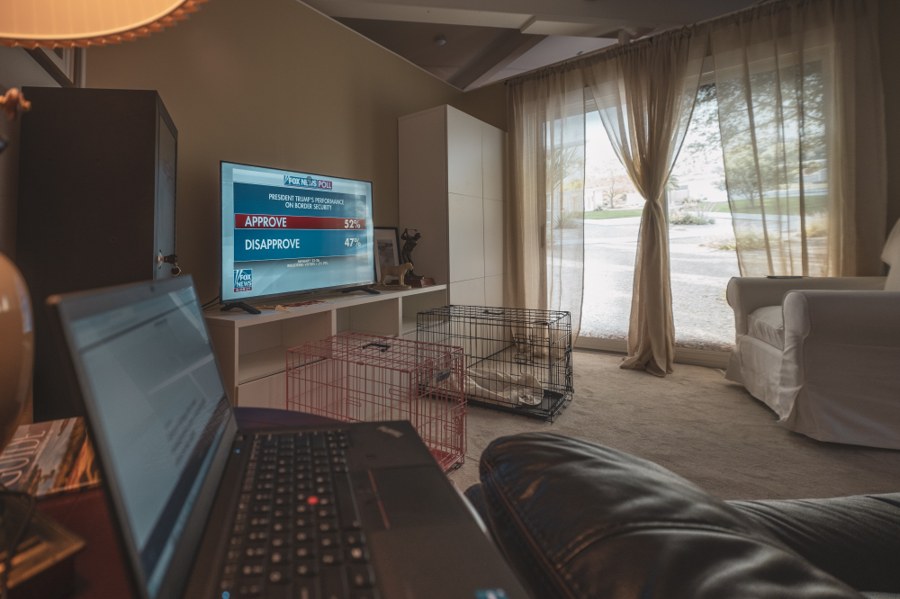
Conservative · Palm Desert, California
White carpet, leather armchair
Two empty dog cages. A safe behind the chair. Fox News, Truth Social, the Wall Street Journal.
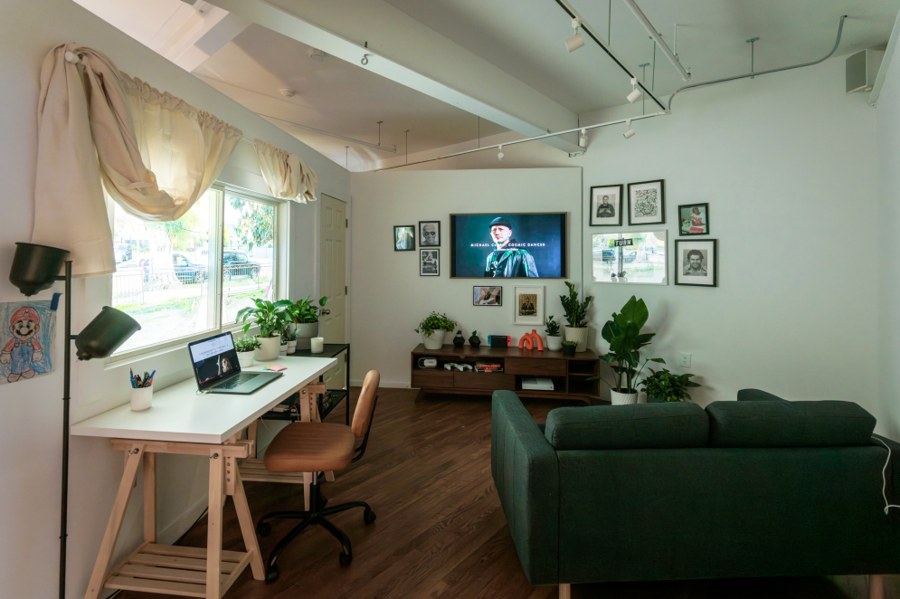
Very liberal · Los Angeles
Upright couch, IKEA desk
An unkempt yard beyond the window. Democracy Now!, footage from a No Kings rally, the LA Times.
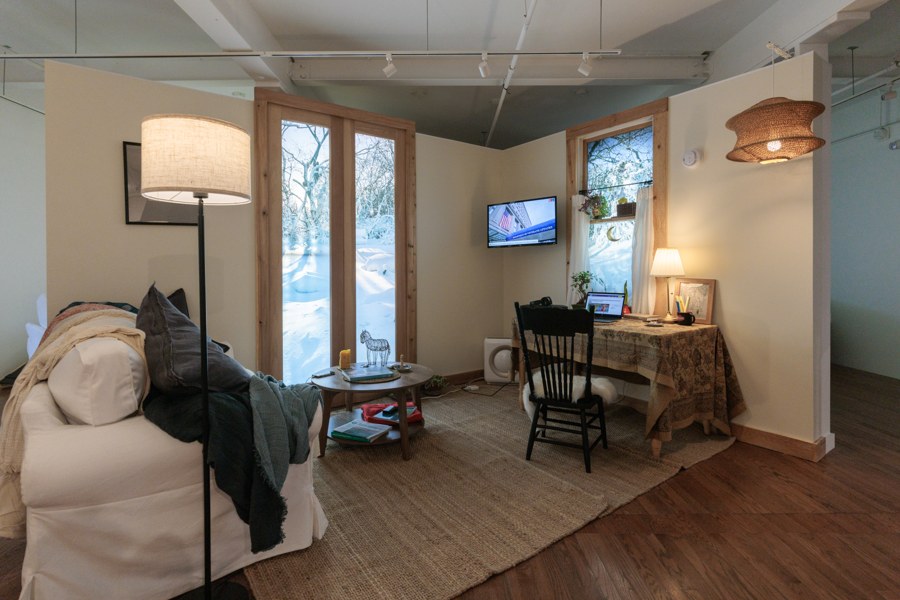
Moderate · Wellfleet, Massachusetts
Batik, bonsai, art books
Fur pelts and a Bose radio tuned to WOMR. NPR, PBS, and a folded copy of the Provincetown Independent — the only print newspaper in the installation.


Why we made it
I spent years reporting abroad for the Washington Post and then working on policy at the U.S. Mission to the United Nations. I sat in Situation Room meetings on Afghanistan. And it felt very distant, almost by necessity — decisions about people's lives taken at a great remove from the rooms those people live in.
The thing I keep coming back to is that political disagreement in America is not usually a disagreement about evidence. Two people can be well-informed, honest, and attentive, and still be working from entirely different inputs. If that is the problem, then fact-checks and charts are the wrong instrument. You have to put someone inside the other reality, in a way that doesn't trigger defensiveness or shame.
Our job is to complicate stereotypes with the reality of these people.
Amar C. Bakshi · Provincetown Independent, April 2026
That is also why it has to be built rather than published. Participants are anonymous — visitors learn location, gender, ethnicity, and approximate age, but not names. What they get instead is the bonsai, the dog cages, the folded newspaper. The details are the argument.
Democracy is a place-based exercise in a very fundamental way. You need to know your neighbors.
Amar C. Bakshi
Provincetown was a pilot. The intention is to build it again, in other places, with other neighbours.
Credits
Co-Creators — Amar C. Bakshi · Heidi Boisvert, who built the technical architecture that lets visitors move between media realities across every screen at once. Project Director Kari Mulholland. Producer Cecilia Parker. Scenic Designer Michael Berens. Set Builders Josiah Noble, Reuben Bechtold. Set Dresser Kat Wright. Creative Technologist Jingyao Shao. Participant & Content Research Maci Morris. Video Patrick Rufino. Web Thor Matthiasson, Lucas Drummond. Social Rhea McTiernan Huge, Sonia Banchez.
Presented by Twenty Summers. Supported by the Arts Foundation of Cape Cod and The Cape Cod Foundation.
- Visit
- ourmediadiet.com →
Stanley, 494 Commercial Street, Provincetown - Press
- Armchair Political Tourism →
Abraham Storer, The Provincetown Independent, April 2026
Touring
Bring Media Diet to your institution.
The installation is designed to travel. We’re seeking partners — museums, universities, libraries, and civic organizations — for future runs, and for use in education, journalism, and community dialogue.
- Museums presenting work on media, democracy, or contemporary life
- Universities exploring polarization, communication, and public opinion
- Libraries and civic institutions hosting community conversations
- Foundations focused on democracy, trust, and social cohesion
- Journalists and educators teaching media literacy