Essay
On designing social worlds
Well-designed environments can reveal our common humanity. This is the account of how I came to believe that, and what it has cost me to keep believing it.
In 1947, my grandmother fled Lahore during partition. She left for India by train at night with fires burning outside her window. Seven years later, at twenty-one, Nani married my grandfather. He was a mapmaker who spent the next thirty years charting the new India–Pakistan border in exquisite detail.
In 2007, sixty years after she fled, I became the first member of my family to go back. I was reporting for The Washington Post, traveling to twelve countries to write about how people saw America. This was the tail end of the Bush years, so the short answer was: not very well.
In Lahore I wrote piece after piece, and Nani read them all, and none of them satisfied her. She wanted to know what her old neighborhood looked like. What life was like for the kids there who were Muslim and did not leave sixty years before. She did not have a friend in Lahore. She just felt a curiosity for the place.
I told her to be patient. Between all the tech giants, surely she would soon be able to connect with whoever she wanted, whenever she wanted. We imagined her touching down as a hologram on the streets of Lahore, talking to passersby. Nani died in 2009. I never stopped waiting for Google or Skype to build that.
By 2013 I was in New Haven at law school, preparing for a life of policy papers and punditry, and I missed reporting acutely. What I missed specifically were the long bus and train rides where my laptop would die, I had no smartphone, and there wasn't enough light to read, so I would talk to whoever was sitting next to me. A father trying to find a distant daughter in the Philippines. A young man heading to madrassa who wanted to be a computer scientist. An aging revolutionary in Mexico on pilgrimage, preparing for his final days.
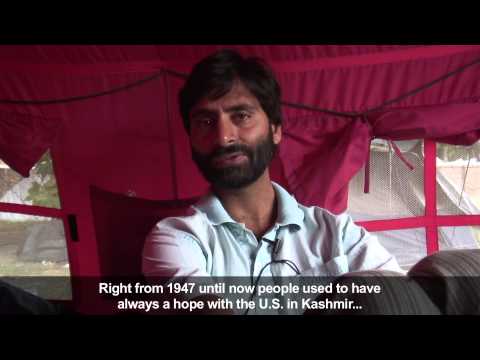
Those were purposeless conversations across pronounced distance. At law school, networking and dating and socializing, I almost never encountered someone I didn't already know, and when I did it was to get a date or land a job. I had not had a conversation with a stranger for no particular purpose in years. I had nearly forgotten the feeling of exiting my own world and listening to somebody else's.
So I began to tilt away from law and policy, toward art. The tilt became a full turn.
Portals began as a daydream.
What if you could enter a door at the back of your local coffee shop in the morning and see live into Lahore? Share your morning coffee with someone sipping their evening tea across the world, as if in the same room? I turned it over constantly and talked about it with anyone who would listen. The most common reaction was that we already had this and it was called Skype. But a subset of people were invigorated by it and jumped in, and over 2014 they helped discipline the daydream until it took physical form.
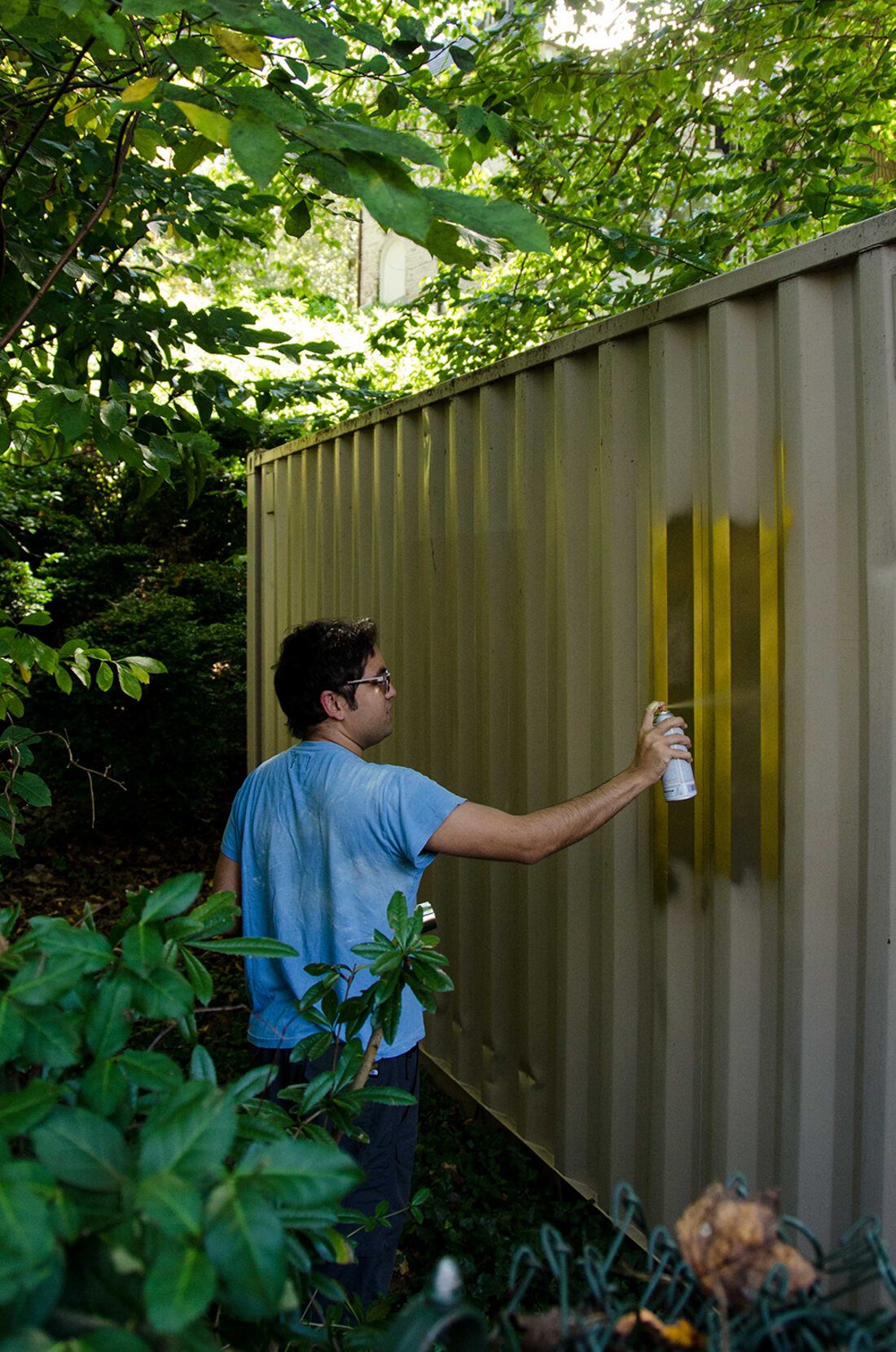
The first discipline was structural. We considered tents, inflatables, and sheds before choosing a standard intermodal shipping container: affordable, omnipresent, securable, uniform, and etched with the markings of its own movement through ports. In August 2014 we broke my parents' lawn fence and dropped a six-meter container on their grass. They weren't thrilled. The neighbors were livid.
Then we had to pick a color, and this is the part I think about most, because it is where the whole thing was decided. White read too artsy. Black read too scary, like a black site. Stripped bare metal was bad for the environment and expensive. Silver looked too precious, light gold too much like money. Dark gold struck. It connoted more of the sacred than the commercial, and it had a sheen in which passersby could see themselves, imperfectly. Inside, we carpeted the walls and ceiling in grey so people would feel protected. We hid the technology behind a wall and put the camera in a drywall door, working with my uncle, an optical scientist, on the perspective distortion.
None of that is technology. A camera, a projector, decent bandwidth — we all had videoconferencing in our pockets already. What changed people was everything around the video.
For two weeks that December we connected an experimental arts space on the Lower East Side to Sohrab Kashani's space in Tehran, one person at a time, eight minutes each, with one prompt: What would make today a good day for you?
The first days were quiet. We put one man in, nobody else showed up on our end, and we forgot about him entirely. Two hours later he startled us by popping out of the container and writing a long essay in gold pen in our gold book. His conversation had started with traffic — a march over the killing of Eric Garner had snarled Manhattan, and in Tehran the pollution was so bad the city was at a standstill. Getting to work led straight into the political, and the political led straight back into sexuality, marriage, ailing parents. They stopped only because the internet in Tehran cut out.
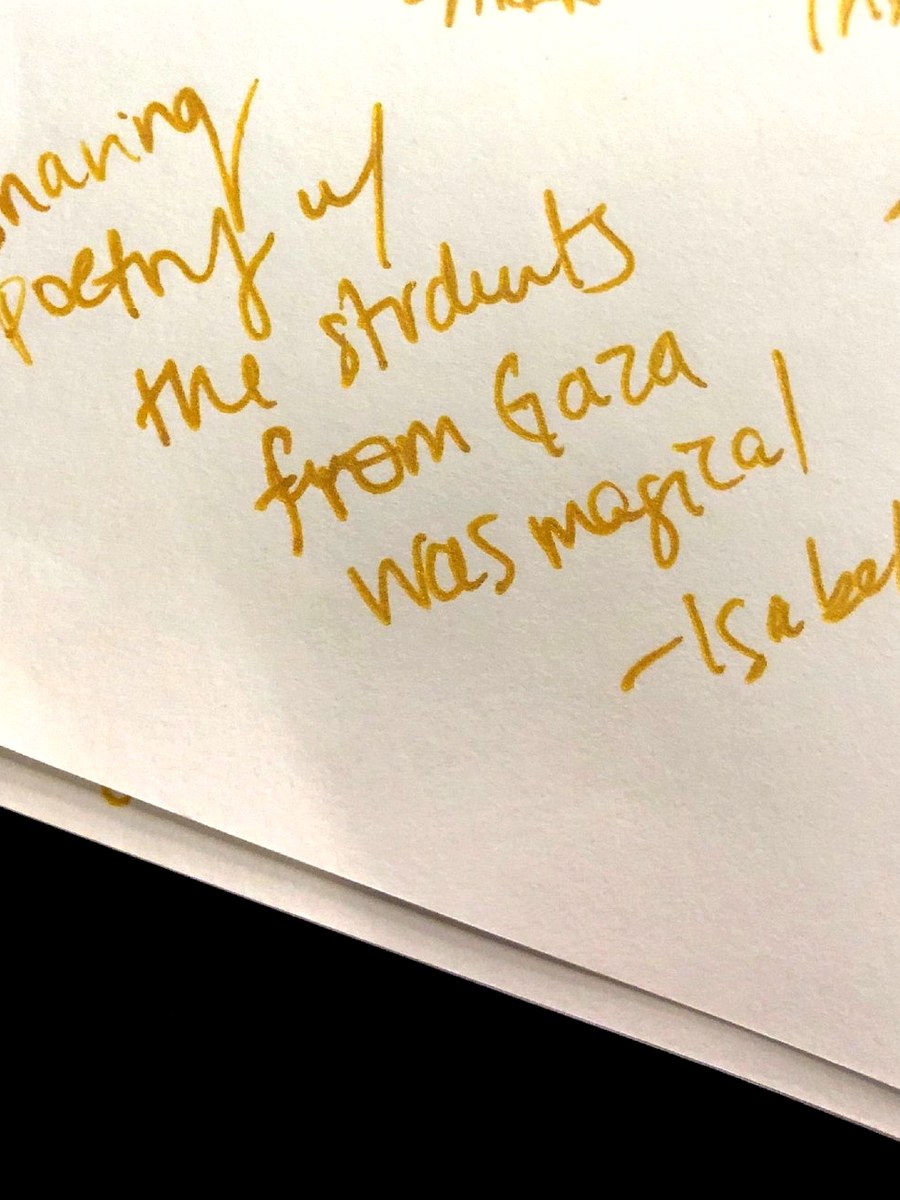
We raised the time to ten minutes, then fifteen, then twenty, and still had to pull people out. They came out weeping, or giddy, and then came back with ideas of their own. James Koroni, an Iranian American dancer who had never visited his family in Iran, performed for them live and came away saying he felt like he was breathing the same air.
Afterward we tried to work out what had happened, because we had expected something neat and maybe cool, not something with that much emotional force. Five things seem to have mattered. The conversations were one-on-one, so nobody could hide behind the most talkative person in a group. They were private — phones don't work in a Portal, nothing gets live-tweeted, and you are unlikely to meet your counterpart again. They felt natural, because you were looking at a whole standing human being who fidgeted and swayed, making eye contact without goggles or headphones. They felt rare. And the context was art, which meant the encounter carried no single purpose. There was no action item, no Swipe Right to stay in touch and no Swipe Left to reject. It could produce joy or irritation or boredom. Nothing was determined in advance, which is also what let people invent their own uses for it.
That purposelessness turned out to be load-bearing. It is why the space worked as a public space rather than a product.
We put about two new Portals a month into the world through 2015 — Herat, Havana, Honduras, Kigali, a Syrian refugee camp in Za'atari, a displacement camp in Erbil. A professor in Herat heard about us on BBC Persian, picked out his own container, carpeted it, painted it gold, and opened it to his city. In Washington, a drone pilot who had flown sorties over Afghanistan spoke for the first time to somebody standing on the ground there.
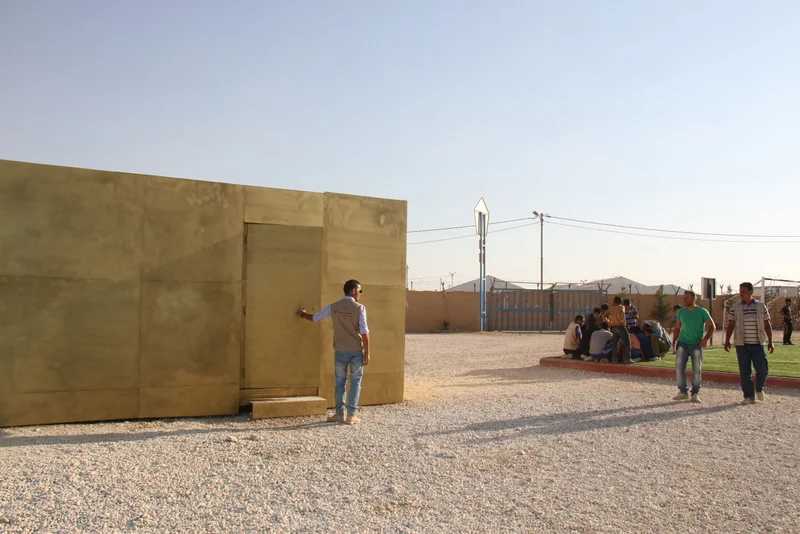
Then a Yale law professor named Tracey Meares came through a Portal to Havana, and afterward we started talking about domestic pairings. We connected the 53206 zip code outside Milwaukee — the highest incarceration rate in the country, which has the highest in the world — to downtown Newark, and recorded the conversations so researchers could study them. That became the Portals Policing Project, and eventually the largest collection of first-hand accounts of policing anyone had assembled.
A survey tells you what people feel. Dialogue tells you, in part, how they came to feel that way.
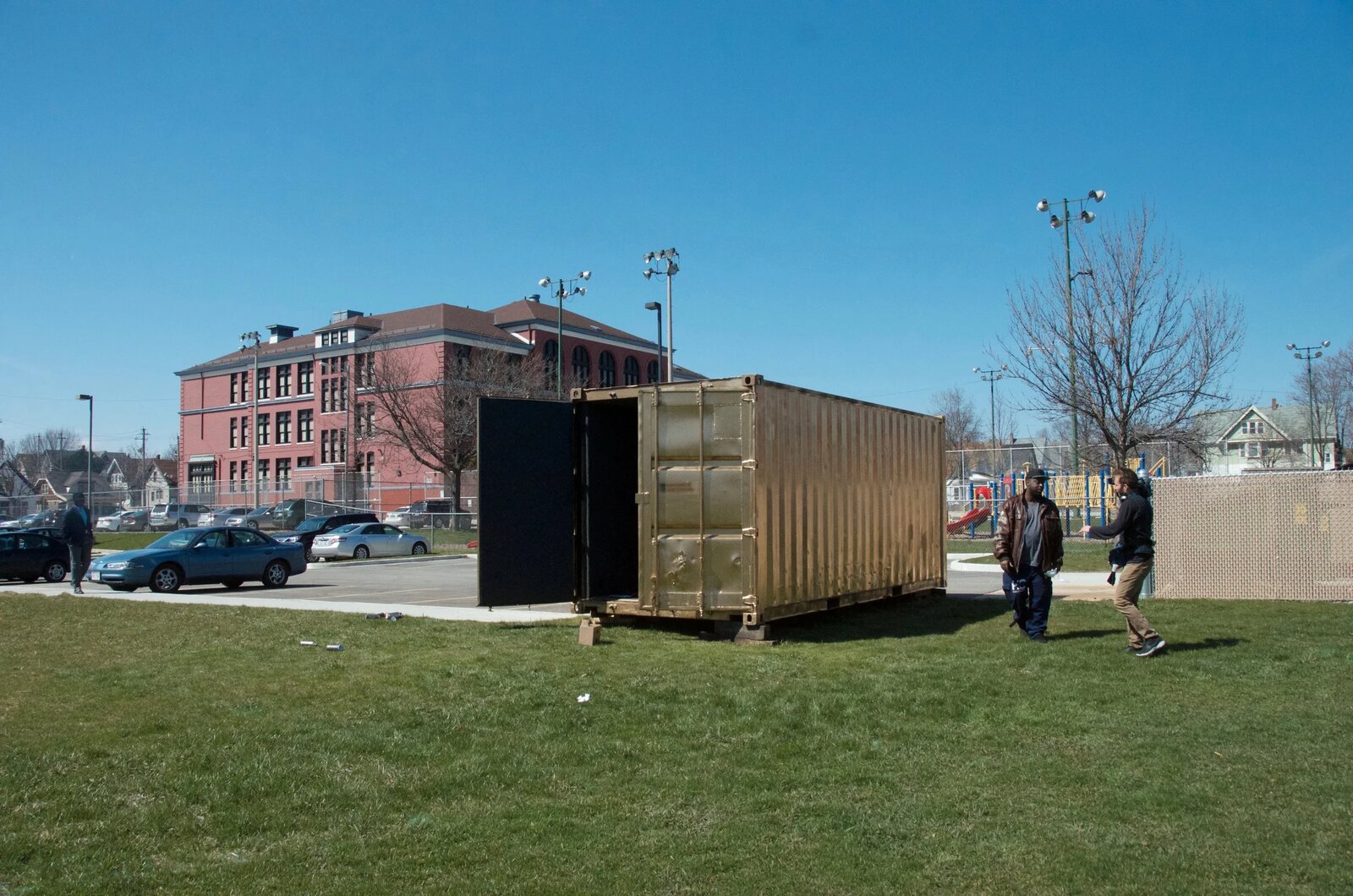
Starting with Tehran and New York invoked a substantial psychic distance. The domestic pairings showed that in most cities you could connect two sides of town and find the distance just as vast, and the dialogue across it just as rare. So Portals was never really about great geography. It was about making a space, a context, and a moment for a certain kind of conversation.
Those conversations create room. They puncture hardened stereotypes of the other. The puncture might not produce harmony or understanding, and it may sharpen a disagreement. But it adds the vast complexity of a human face.
Nearly a million people went through those doors over ten years, across 77 sites in 43 countries. Which is the finding I keep returning to: people are better than their information environments.
Put almost anyone in a well-designed room with someone they were told to fear, and within twenty minutes they are talking about their kids, their music, what would make today a good day.
Once you have seen a room do that, you start seeing rooms everywhere, and you notice that almost none of them were designed. The standup. The all-hands. The town meeting. The way a court turns a conflict into a procedure. The way a newsroom decides what a million people worry about today. All of it was made by somebody, usually a long time ago, for conditions that no longer hold. Anything that was made can be remade. As a law student I helped run a symposium at Yale on artists who use law itself as material, the way a sculptor uses steel, and that framing has stayed with me since.
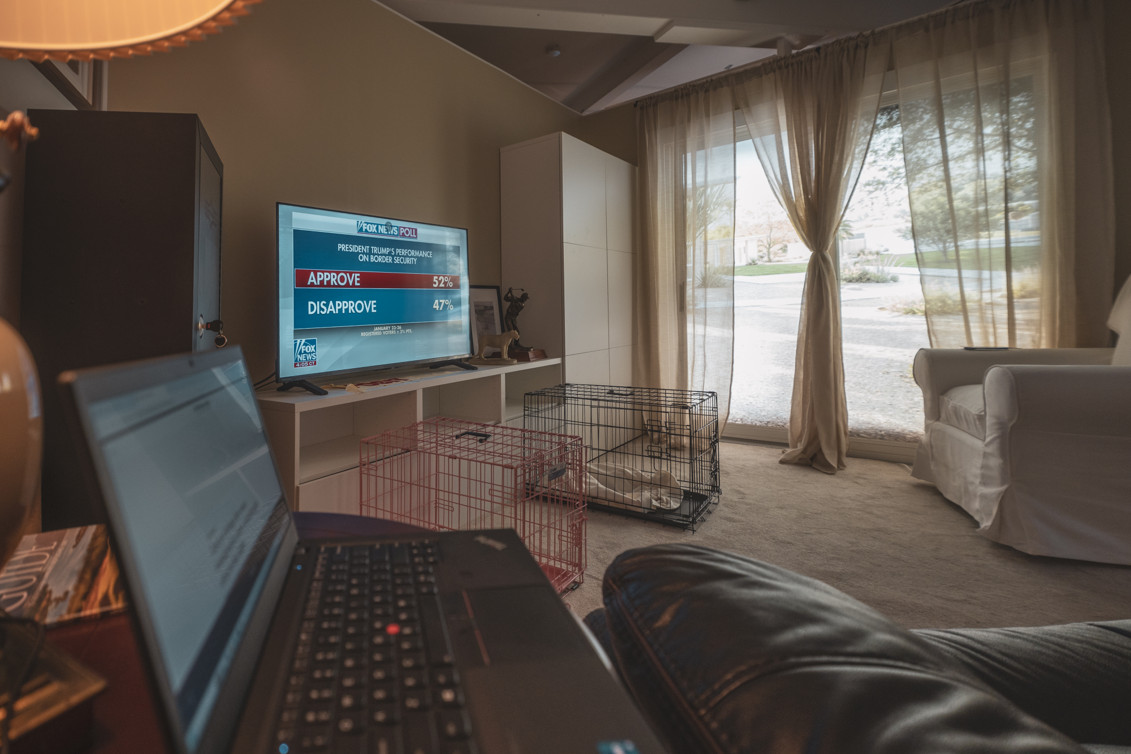
Prototypes want to become infrastructure, so the work split. The presence technology in the Portals became Noro, which connects distant workplaces at life size. The interest in information environments — which started when I spent a year in Zimbabwe studying how a government took control of the culture in order to control the media — became Media Diet, where you walk through the rebuilt living rooms of three real Americans and watch one news story split into three realities. The question of what institutions we owe each other became New Social Forms at MIT, and Portfolio, and Andus Labs.
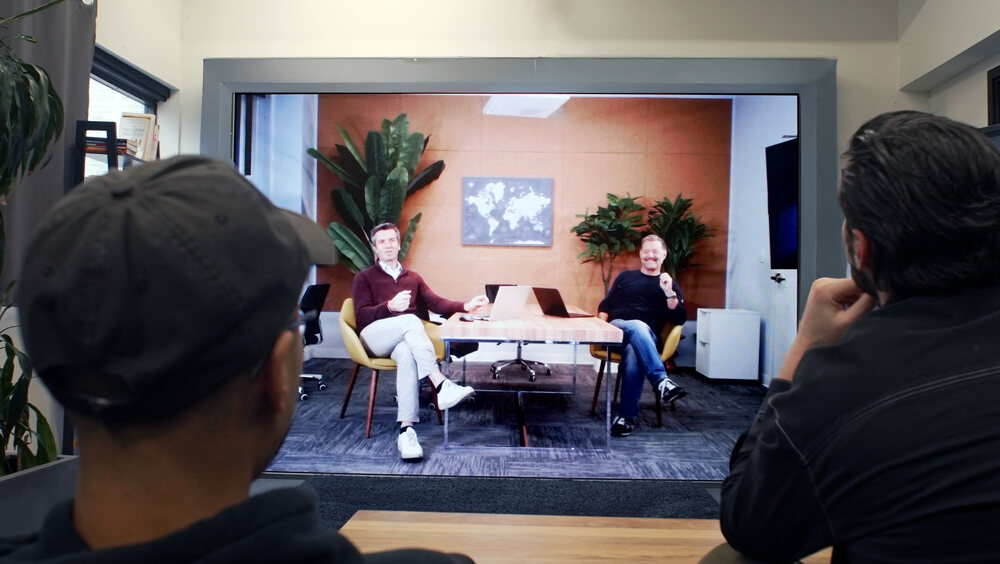
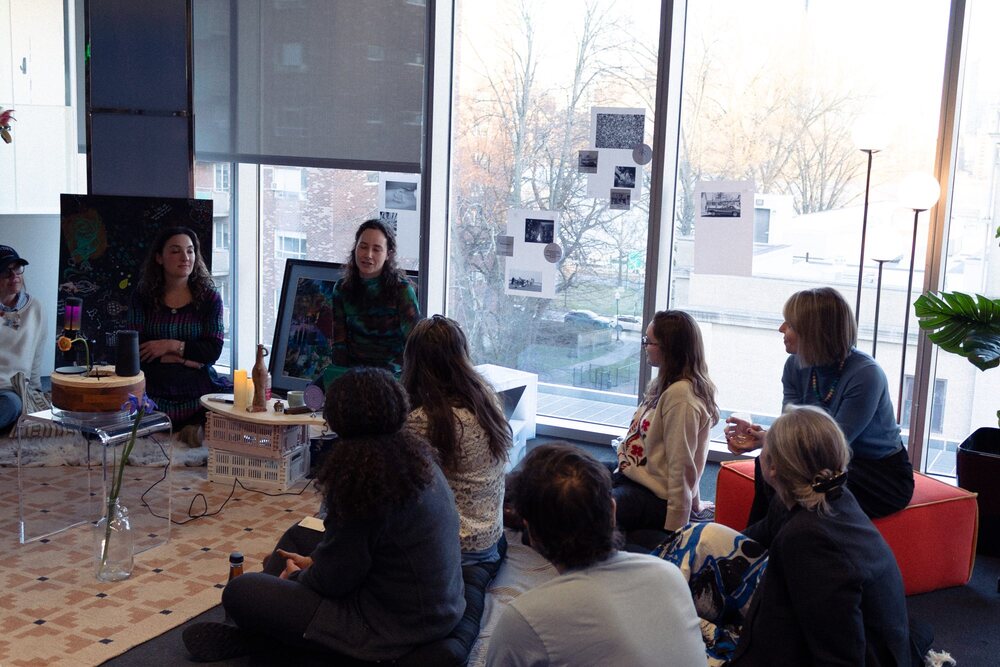
That last one is the most intimate redesign now underway: what happens to human work when a machine joins the meeting. AI will sit in our meetings, draft our documents, tutor our children, and offer itself as company that never disagrees with us. Whether that isolates us or connects us is a design question, and it is the same one I have been working on all along, at higher stakes. A world where machines take the transactional could free people for the harder encounters. It could also quietly remove the last occasions where strangers have to deal with one another at all. Both are buildable. Somebody is going to build one of them.
The vision keeps getting clearer. Disciplining it is always the challenge.
Working on Portals made me look again at how much of this came from my grandmother. The gold I settled on is the color of the small statues of Hindu gods she kept on her dresser. The grey carpet that reads as safety is the color and texture of the movie hall she used to take me to as a child. And the idea of looking at one other human being in isolation, worthy of appreciation by virtue of existing, is the idea inside the greeting she used — Namaste, bowing to the divine in another person. Every other person.
The capacity is there. It has always been there. It's the conditions that fail, and conditions can be designed.
Amar C. Bakshi · Brooklyn, 2026
The work referred to here
Current initiatives
- New Social FormsGroups · MIT CCC
- Andus LabsOrganizations
- PortfolioSocieties
- NoroPresence, made permanent
The foundational experiment
- Shared StudiosPortals · 2014–present
- The gold booksWhat people wrote on the way out
- Research on PortalsWhat was measured
- Global WeThe climate conversation
- The Policing ProjectPortals as research tool
The wider investigation
- Media DietThree Americans, three realities
- The Legal MediumLaw as artistic material
- Whose FutureA public technology garage
- How the World Sees AmericaThe Washington Post
- Race in '08The 2008 campaign
- Promoting Local Culture to Repress DissentHarvard thesis · Zimbabwe
- Selected pressCoverage and recognition
For funders, partners, and hosts
Conditions can be designed. Let's design some.
If you are building a room, an institution, or an occasion where people who differ have to meet well, I would like to hear about it.