Shared Studios · The story of Portals
Portals began as a daydream.
In 1947, my grandmother fled Lahore during partition. She left for India by train at night with fires burning outside her window. Seven years later, at twenty-one, Nani married my grandfather, a mapmaker who spent the next thirty years charting the new India–Pakistan border in exquisite detail.
In 2007, sixty years after she fled, I became the first member of my family to return. I was reporting for The Washington Post, traveling to twelve countries over a year to write about how people perceive America. In Lahore I wrote piece after piece, and Nani read them all, but none of them satisfied her. She wanted to know what her old neighborhood looked like. What life was like for the kids in it who were Muslim and did not leave sixty years before. She did not have a particular friend there. She just felt a curiosity for the place.
I told her to be patient — that between all the tech giants she'd soon be able to connect with whoever she wanted, whenever she wanted. Together we imagined a future where she could touch down as a hologram on the streets of Lahore and talk to whoever walked past.
Nani passed away in 2009. I never stopped waiting for Google or Skype to make that vision real.
By 2013 I was in New Haven at law school, preparing for a life of policy papers and punditry, and I found I missed reporting acutely. Specifically I missed the long bus and train rides where my laptop would die, I had no smartphone, and there wasn't enough light to read, so to pass the time I'd strike up a conversation with the stranger next to me. A father trying to find a distant daughter in the Philippines. A young man in Pakistan heading to madrassa, keen on becoming a computer scientist. An aging revolutionary in Mexico on pilgrimage, preparing for his final days.
Those were de-instrumentalized conversations — purposeless ones, across pronounced distance. Meanwhile I was networking on LinkedIn, dating on Tinder, and posting the joys of my life and not the sorrows on Facebook. Every tool was pointed at an outcome. I had not had a conversation with a stranger for no particular purpose in years, and I'd nearly forgotten the feeling of exiting my own world and listening to someone else's.
What if you could share your morning coffee with people sipping their evening tea across the world, as if in the same room?
That was the daydream: a door at the back of your local coffee shop that opens onto Lahore. I turned it over constantly and told anyone who would listen. The common reaction was "we already have this, it's called Skype." But a subset of people were invigorated by it and jumped in, and over 2014 those people helped discipline the daydream until it took physical form.
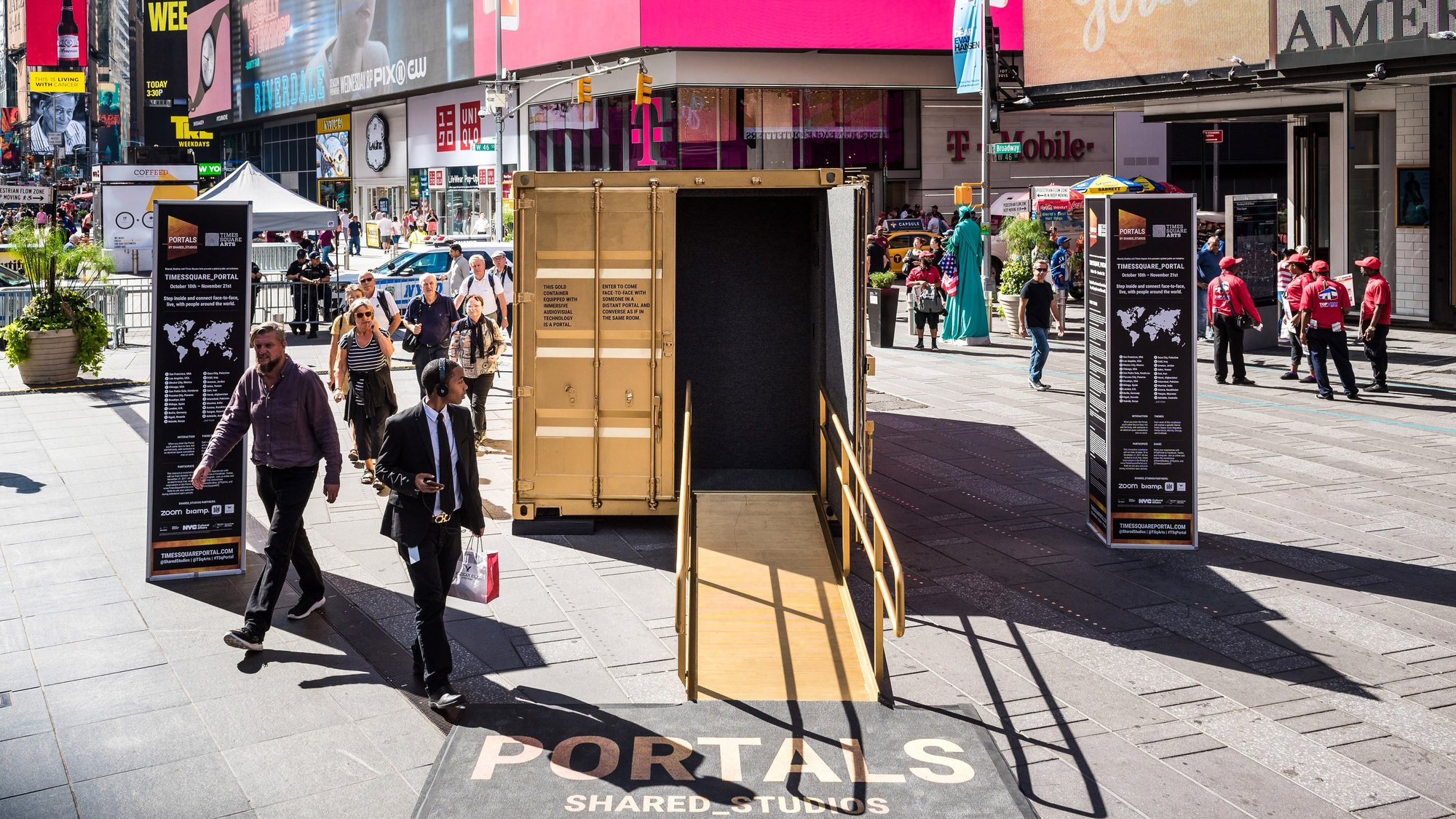
The first discipline was structural. My partner John Farrace, an architect by training, and I considered tents, inflatables, and sheds before choosing a standard intermodal shipping container — affordable, omnipresent, securable, uniform, and symbolically rich. Etched into each old container are the markings of its movements through ports around the world.
In August 2014 we did what my parents had long dreaded: broke the lawn fence in their backyard and dropped a 6-meter container on the grass. They weren't thrilled. The neighbors were livid. They complained to the police, first claiming I was living in it, then insisting it was an eyesore regardless. On the second point I agreed.
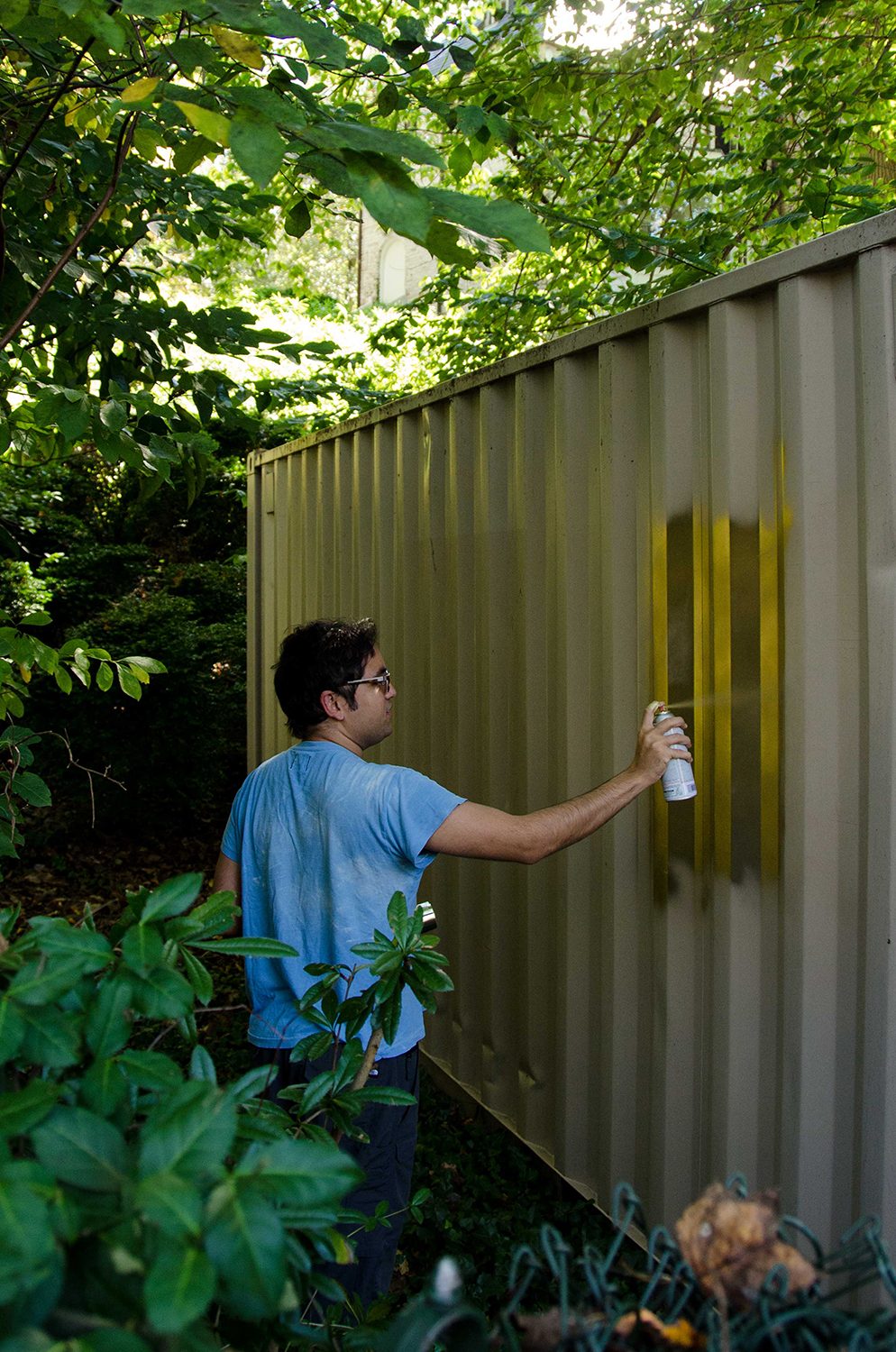
So we tried colors. White was too artsy. Black too scary, like a black site. Stripping the paint to shine the metal was bad for the environment and costly. Silver looked too precious, light gold too much like money. A dark gold was the one that struck — it connoted the sacred rather than the commercial, and it had a sheen in which passers-by can see themselves, but imperfectly.
Inside, we covered the walls and ceiling in grey carpet so people would feel protected. At the far end we set a small camera into a drywall door, working with my uncle, an optical scientist, to deal with perspective distortion. Everything else — projector, speakers, microphone — stayed hidden. You enter the gold container into a grey room, and on the far wall you see the interior of an identical Portal abroad.
As a final touch we stenciled the front: "A Portal to Iran or Pakistan." That was too much for one neighbor, who called the FBI to report a possible terrorist cell. The FBI investigated the container and me for a couple of days and determined that the gold box was not a terrorist cell. It was a Portal. We were cleared.
The structure was ready; we needed the pair of locations. I'd wanted to connect an arts space in the US to somewhere in the Middle East or South Asia, but since Nani died I had no particular place in mind. Michelle Moghtader, my earliest partner, knew exactly where she wanted one.
Michelle is Iranian American, and in 2014 she was a journalist reporting in and out of Tehran. Her assignments were always nuclear negotiations and oil, and in Tehran she watched the Iranian press cover America just as narrowly. She wanted her friends in both countries to see past what the press was giving them. Over 2014 she went to Tehran repeatedly, facing opposition, worries about the government, and doubts about internet speeds, until she found Sohrab Kashani, the artist and curator behind the Sazmanab Center for Contemporary Art.
Sohrab's own work was about grounding technology in physical space. Denied a US visa, he had once hired a stranger to walk around America wearing a live microphone and web camera, acting as his human avatar. Sohrab saw through the stranger's eyes and spoke through his mouth. "Hello, this is Sohrab from Tehran," the avatar would say, walking through Central Park. He had built his own hologram abroad. He understood Portals immediately, and built an identical interior in Tehran.
By December 2014 we had two Portals: one in an experimental arts space on the Lower East Side, one in Tehran. For two weeks we invited people in one at a time for eight-minute conversations with a stranger on the other side, on a single prompt: What would make today a good day for you?
The first few days were quiet. We put one man in, nobody else showed up on our end, and we forgot about him. Two hours later he startled us all by popping out. He'd spent the whole time with a stranger in Tehran, and came out and wrote a long essay in gold pen in our gold book. His conversation had started with getting to work — a march protesting the death of Eric Garner had snarled Manhattan; in Tehran the pollution was so bad the city was at a standstill. The mundane tied instantly into the political, and the political into the personal, and they talked about sexuality, marriage equality, and ailing parents. They stopped only because the internet in Tehran cut out.
As the days went on we raised the base time to ten minutes, then fifteen, then twenty, and still had to pull people out. People came out weeping, or giddy, and many came back with ideas for what they wanted to do in there next. So after a few hours of one-on-one conversations each day we started letting people take the space. An Iranian American dancer named James Koroni, who had never visited his family in Iran, performed for them live as if in the same room, and came away saying he felt like he was breathing the same air. School groups brought in a substitute teacher from Tehran. A jazz musician in New York wrote a new piece with a classical Persian musician in Tehran.
The first eighteen months
Why it worked
We expected the experience to be neat, unexpected, maybe cool. We were surprised to find it had such an emotional effect. Looking back, five things seem to have done it.
-
The conversations were one-on-one
Nobody could hide behind the most talkative person in a group. Each side was half responsible for making something of the time.
-
They were private
Cell phones don't work in a Portal. Nothing was live-tweeted. You were unlikely to meet your counterpart again, so what you said wasn't going to make its way back to your friends. That lowers the pressure to perform.
-
They felt relatively natural
Instead of a disembodied head on a screen, you faced a full, standing human being — fidgeting, swaying — and made direct eye contact, unencumbered by goggles or headphones.
-
The encounter felt rare
Connecting Tehran and New York tapped an evocative distance. The pairing made the connection feel like receiving a pen-pal letter after a month's wait.
-
The context was art, so it had no single purpose
This is the most important one. There was no action item afterward, no swipe right to stay in touch or left to reject, no bottom-line goal to increase empathy or grow a user base. The encounter was there to behold. It could bring joy, irritation, insight, or boredom, and no particular reaction was called for. That purposelessness is also what opened the space up, so participants invented their own uses for it.
Two weeks after the New York–Tehran Portal closed, an email arrived from Herat. Omid Habibi, a computer science professor who'd heard about Portals on BBC Persian, wanted one at his university. We spoke on Skype a couple of times and he got to work: picked out a container, brought it to campus, carpeted the inside, painted the exterior gold, installed the tech, and hosted an opening for the city. Herat became our first permanent Portal, running since March 2015.
In Washington, a drone pilot who had flown sorties over Afghanistan for years entered the Portal and spoke, for the first time, to someone on the ground there. A former Department of Defense worker wrote in the gold book: "In the four months I was there, I never had a connection with an Afghan citizen that was close to as powerful, as moving, as I did standing in that gold box. I was moved almost to tears…. In Afghanistan, when I was there, everything was deliberate. Everything was planned."
Through 2015 we added roughly two locations a month: Cuba, Honduras, Mexico, Rwanda, a Syrian refugee camp in Za'atari, an internally displaced persons camp in Erbil, several US cities, and Germany. Every hub connects to every other. Each is staffed by a full-time Portal Curator who interprets live, engages the surrounding community, and helps people realize their own ideas in the space.
One story stays with me. An elderly woman in the US who had fled Cuba as a child was ill and low, and a friend surprised her by bringing her to a Portal to cheer her up. She spoke to someone in Cuba — the first time she'd communicated with anyone in the country since she left decades before. The stranger turned out to be a young man who had grown up on the very same street. She came out dancing and laughing, with a tinge of the bittersweet, having reignited a connection near the end of her life. Then more than ever, I thought of Nani.
Another visitor who spoke to Havana was Tracey Meares, a professor at Yale Law School. Afterward we talked about pairing Portals inside the United States, starting with the criminal justice system, and in 2016 we connected the 53206 zip code outside Milwaukee to downtown Newark. Residents talked about policing, race, and justice: people who had been incarcerated repeatedly, their families, their neighbors, and police officers. For the first time the conversations were anonymously recorded and transcribed so researchers could study how communities build their narratives.
A survey tells you what people feel. Dialogue tells you, in part, how they came to feel that way.
We began by connecting Tehran and New York, invoking a substantial psychic distance. The domestic pairings made a different point: in most cities you could connect two sides of town, because the local distances are often just as vast and the dialogue across them just as rare. Portals is not really about great geography. It is about making a space, a context, and a moment for a certain kind of conversation — and, we hope, about prompting people to put the phone down on the bus and talk to whoever is sitting there.
The talk
Art opens space to probe essential character — someone else's, and your own. Working on Portals made me look again at how much of this came from my grandmother. The dark gold I settled on is the color of the small statues of Hindu gods and goddesses Nani kept on her dresser. The grey carpet that reads as safety is the color and texture of the movie hall she used to take me to as a child. And the idea of looking at another person in isolation, worthy of attention just by virtue of existing, is the idea inside the greeting she used: Namaste — bowing to the divine in another human being. Every other human being.
Where the story goes next
The gold books
1,467 entries written by hand inside the Portals, transcribed and searchable.
The Portals Policing Project
What the Milwaukee–Newark pairing became: the largest collection of first-hand accounts of policing in America.
Research on Portals
What scholars found when they studied the conversations.
On designing social worlds
What Portals taught me that carried into everything after it.